
Maricopa County Assessor maps give a simple way to search and view property data on an interactive map. Users can enter a parcel number, owner name, or street address to locate a property within seconds, making parcel lookup fast and accurate. The map shows clear property boundaries, zoning maps, and nearby land parcels in one view. It supports smooth navigation with zoom and pan tools, so users can focus on specific locations without confusion. This tool works well for buyers, homeowners, and real estate professionals who need reliable property data search and land records. In the middle of the search process, users can switch layers to explore more details like land use and satellite view.
Maricopa County Assessor GIS viewer helps users explore GIS maps, geospatial data, and parcel mapping in a visual and easy format. It allows users to check ownership details, lot size, and surrounding parcels with clear boundary highlights. The tool brings together land mapping, parcel ID search, and zoning information in one place for better decision-making. Users can compare properties, review nearby parcels, and understand land divisions without extra steps. In the middle of any search, the viewer updates instantly as users move across the map or adjust layers.
What Are Maricopa County Assessor Maps?
Maricopa County Assessor maps are official county maps showing property boundaries and parcel details. They are used to track ownership and provide accurate information for property taxation. These maps help residents, planners, and real estate professionals visualize land divisions across the county. By linking properties to unique parcel numbers, the Maricopa County Assessor ensures each parcel is identified clearly for tax and administrative purposes. Assessor maps are part of a parcel-based mapping system, which organizes land into identifiable units for both legal and fiscal records. These maps not only outline property dimensions but also show structures, easements, and zoning classifications. They form the backbone of the county’s property management system and support transparency in land ownership records.
How the Parcel-Based Mapping System Works
The parcel-based mapping system organizes every property into individual parcels, each assigned a unique parcel number. This setup helps officials track property ownership, calculate taxes, and maintain accurate records for legal and administrative purposes. It ensures property data is consistent, reliable, and easy to reference for public and government use.
Key elements of this system include:
- Parcel ID or number for each property
- Detailed lot size and dimensions
- Zoning classifications and land use types
- Current and previous ownership records
Role in Taxation and Land Ownership
Land ownership maps help determine who owns each parcel and how property boundaries are defined. They play a critical role in preventing disputes, maintaining accurate tax assessments, and supporting county planning initiatives. These maps also provide essential information for real estate transactions and resource management.
Benefits of assessor maps include:
- Clear identification of taxable areas
- Easy reference for property boundary disputes
- Accurate tracking of past and present ownership
- Support for planning and development projects
The Maricopa County Assessor updates these maps regularly to reflect new constructions, subdivisions, and boundary adjustments. This ensures property records remain precise and property owners are assessed accurately. Assessor maps provide a clear, organized view of county properties, helping residents and officials manage land efficiently.
How to Use the Maricopa County GIS Map Viewer
The Maricopa County GIS Map Viewer is an interactive platform for viewing property boundaries, zoning, and parcel information. Users can search properties by address or parcel number, toggle map layers, and examine detailed ownership data. The viewer supports accurate property research and helps residents, planners, and real estate professionals track land ownership across the county. Using this system ensures clarity and reliability for tax purposes, property management, and urban planning.
Access the official GIS Map Viewer here: https://maps.mcassessor.maricopa.gov
Search by Address or Parcel Number
The first step in using the GIS viewer is locating the property. Users can type either a property address or a parcel number (APN) in the search bar. This search immediately highlights the parcel on the map and provides access to ownership and tax information. It simplifies property lookup and ensures you can find the correct parcel without confusion.
- Enter the full street address or parcel ID
- Click the Search icon to locate the property
- The system highlights the parcel on the map
- View details in the side panel for more information
Navigate Map Layers (Zoning, Aerial, Boundaries)
After locating a property, users can explore GIS layers to see zoning information, aerial views, and parcel boundaries. Layers provide context about land use, nearby developments, and legal boundaries. Switching layers helps users visualize both the legal and physical aspects of a property, which is especially useful for planning, development, or verification purposes.
- Toggle parcel boundaries to see lot lines clearly
- Enable zoning overlays to view land use classification
- Turn on aerial imagery for a real-world view of the property
- Combine multiple layers for a complete picture
View Property Details on Map
Clicking a highlighted parcel opens a detailed panel with ownership and property information. This feature provides insights into property boundary maps and other important data such as lot size, ownership history, and tax assessments. Users can view both current and historical details directly from the map, saving time and eliminating the need to consult separate records.
- Parcel ID and owner name
- Lot size and dimensions
- Sale history and tax summary
- Additional zoning or land use restrictions
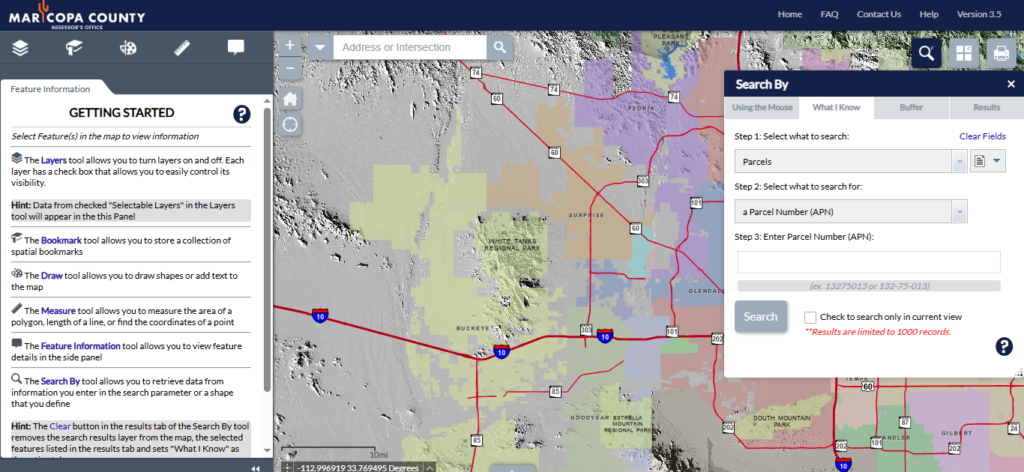
Features of Maricopa County Parcel Map Viewer
The Maricopa County Parcel Map Viewer is a comprehensive parcel map Maricopa County tool designed to help residents, developers, and planners interact with property data easily. It provides detailed information about property boundaries, zoning, ownership, and geographical context. Users can explore parcels visually, analyze land use, and access official property data, all from a single platform. The tool supports accurate property research, urban planning, and decision-making by combining maps, layers, and interactive features.
Interactive Property Boundaries
The viewer displays precise parcel boundary lines, allowing users to see exact lot sizes and shapes. Interactive boundaries highlight the selected property when clicked, providing immediate information about ownership and legal dimensions. This visual representation is essential for verifying property extents and understanding neighboring parcels.
- Click a parcel to view its boundary highlighted on the map
- Access property IDs, owner details, and lot size
- Zoom and pan to inspect surrounding parcels
- Compare multiple parcels quickly on the same map
Zoning and Land Use Layers
Users can enable zoning and land use layers to understand how each parcel is designated under county regulations. These overlays help identify whether a property is residential, commercial, industrial, or open space. They are critical for developers, planners, and prospective buyers looking to evaluate property potential.
- Toggle zoning overlays to see land use types
- Overlay multiple land use categories for comparison
- Identify restrictions or special planning designations
- Analyze how parcels relate to neighboring properties
Aerial & Satellite Views
The map supports aerial and satellite views, giving users a real-world perspective of properties. High-resolution images allow visualization of buildings, vegetation, roads, and other physical features. This feature complements parcel boundaries, making it easier to assess land characteristics for development or investment purposes.
- Switch between aerial, satellite, or hybrid views
- Zoom in for detailed inspection of property features
- Compare historical imagery to see changes over time
Measurement Tools (Distance & Area)
The viewer includes map measurement tools to calculate distances and areas directly on the map. These tools are useful for land assessments, planning construction, or verifying parcel sizes. Users can measure single parcels or multiple areas for comparison.
- Draw lines to measure distance between points
- Calculate area for irregular parcels
- Export measurement results for reports or planning
- Combine measurements with layer data for precise analysis
Print & Export Map Options
Users can print or export maps directly from the viewer. This allows sharing property layouts, zoning, and measurements with clients, officials, or colleagues. Export formats often include PDF or image files, preserving both visual and data layers.
- Print maps with selected layers visible
- Export parcel boundaries and measurements for offline use
- Customize map layout and orientation before printing
- Share maps for presentations or official submissions
Types of Maps Available in Maricopa County GIS
The Maricopa County GIS system provides a variety of maps that allow users to understand property, zoning, land use, and tax districts across the county. These maps are essential for residents, real estate professionals, urban planners, and developers who need accurate information about parcels, ownership, and regulations. Each map type serves a specific purpose, making the GIS system a versatile tool for research and decision-making. By offering multiple map types, the system ensures users can access detailed property and land information, enhancing transparency and helping with planning, investment, and property management.
Parcel Maps
Parcel maps Maricopa County display property boundaries, lot sizes, and parcel IDs for all county properties. These maps are the foundation for property research, tax assessments, and ownership verification. Users can click on parcels to view ownership details, legal descriptions, and land dimensions.
- View detailed parcel boundaries for individual properties
- Access owner information and parcel identification numbers
- Understand lot sizes, shapes, and adjacency to neighboring parcels
- Combine with zoning and land use layers for comprehensive property analysis
Zoning Maps
Zoning maps Maricopa County illustrate land use regulations, showing whether parcels are designated residential, commercial, industrial, or open space. These maps help developers, planners, and property owners understand legal restrictions and permitted uses for each property.
- Toggle zoning layers to identify permitted land uses
- View zoning overlays in combination with parcel boundaries
- Plan developments according to local zoning regulations
- Identify special zoning districts or overlays for regulatory compliance
Land Use Maps
Land use GIS maps provide information on the actual usage of land, including residential, commercial, agricultural, and recreational areas. Unlike zoning maps, land use maps reflect how properties are currently utilized, supporting analysis of development trends and urban planning.
- Identify areas used for specific purposes, like parks, agriculture, or housing
- Compare current land use against zoning restrictions
- Plan infrastructure, public services, or future development
- Evaluate property trends and neighborhood growth
Aerial Maps
Aerial imagery Maricopa gives users a real-world visual perspective of properties and their surroundings. High-resolution satellite and aerial views show buildings, vegetation, roads, and terrain features. This helps users verify property layouts and physical conditions without visiting in person.
- Switch between aerial, satellite, and hybrid views
- Zoom in for detailed inspection of property features
- Compare historical imagery to assess development changes
- Enhance parcel maps and zoning layers with real-world visuals
Tax District Maps
Tax district boundaries illustrate the jurisdictions responsible for property taxation, including school districts, municipalities, and special districts. These maps help property owners and officials determine tax rates and funding areas.
- Identify which tax district a property belongs to
- Understand overlapping districts for accurate tax assessment
- Plan property purchases or developments considering tax obligations
- Use in conjunction with parcel and zoning maps for comprehensive analysis
Property Boundaries & Parcel Lines
Property boundaries define the legal limits of ownership for any parcel of land. Knowing these boundaries is essential for property owners, buyers, and real estate professionals. Parcel lines are visual representations of these boundaries on maps, helping users understand property extents, identify neighboring parcels, and prevent disputes. Accurate mapping ensures ownership rights are clear and property management is precise. GIS mapping technology makes it possible to combine cadastral mapping with real-world measurements, providing a reliable way to view property boundaries digitally. Users can access parcel identification numbers, lot dimensions, and ownership details through official county maps, reducing confusion and errors in property transactions.
What Parcel Lines Represent
Parcel lines on maps show the outline of a property, indicating its legal boundaries. These lines help users distinguish one property from another and understand the spatial layout of land across the county.
- Highlight the exact limits of a parcel of land
- Show how each lot relates to adjacent parcels
- Provide parcel ID for property identification and records
- Support property research and planning decisions
Legal vs Visual Boundaries
While parcel lines give a visual reference, legal boundaries are defined by deeds, surveys, and official documents. Sometimes the visual representation on a GIS map may slightly differ from legal surveys due to mapping tolerances.
- Legal boundaries are the official property limits
- Visual boundaries on maps help identify parcels quickly
- Survey discrepancies may occur due to measurement methods
- Maps provide a general, highly accurate reference for property layout
How GIS Accuracy Works
Modern GIS tools enhance the precision of parcel maps. Using satellite imagery, GPS data, and cadastral records, GIS maps provide highly accurate representations of property boundaries. This technology allows for reliable parcel identification and detailed property analysis.
- Combines cadastral data with geographic coordinates
- Updates parcel lines when boundaries change or subdivisions occur
- Provides a reference for surveying, planning, and legal purposes
- Ensures transparency in land ownership and property assessments
Zoning Maps in Maricopa County
Zoning maps Maricopa County show how land is classified for different types of use, such as residential, commercial, industrial, or open space. These maps help property owners, developers, and planners understand what activities are allowed on a parcel of land. Using zoning maps ensures compliance with county regulations and supports informed decisions regarding property investments, construction, and development projects. The GIS-based zoning maps combine visual and legal information, making it easier to identify zoning designations and restrictions. By integrating parcel data, users can view not only the type of zoning but also the exact boundaries of each property and how zoning affects neighboring parcels.
Residential vs Commercial Zoning
Residential zoning typically allows for housing developments, ranging from single-family homes to multi-family apartments. Commercial zoning, on the other hand, permits businesses such as shops, offices, and restaurants. Understanding the difference is crucial for property planning and development.
- Residential zones: single-family homes, duplexes, apartments
- Commercial zones: retail, office spaces, mixed-use buildings
- Identify permitted uses for each zoning category
- Assess whether a property meets your intended use or investment goals
How Zoning Impacts Property Use
Zoning affects what can be built, how land can be used, and even property values. It also governs setbacks, height restrictions, and lot coverage. Being aware of zoning classifications is essential for developers, investors, and homeowners.
- Determine land use restrictions and permitted activities
- Plan construction or remodeling within legal limits
- Evaluate potential for rezoning or variance applications
- Understand the impact of zoning on property value
How to Check Zoning via GIS
The Maricopa County GIS system allows users to check zoning designations easily. By accessing the official parcel map, users can select a property to see its zoning overlay and related information.
- Open the GIS map viewer (https://maps.mcassessor.maricopa.gov)
- Search by address, parcel ID, or owner name
- Toggle the zoning layer to view zoning type
- Click on the parcel to view zoning details and restrictions
How Accurate Is Maricopa County GIS Data?
Maricopa County GIS data provides a highly reliable representation of property boundaries, parcel information, and land use. It is based on official records from the Assessor’s Office, survey data, and other county sources, ensuring strong geospatial data accuracy. Users can trust the maps for planning, property research, and legal purposes, though minor differences may exist compared to physical surveys. The system combines multiple datasets, including cadastral records, aerial imagery, and GIS layers, to deliver accurate information. This integration allows users to see both legal parcel boundaries and real-world visual representations of properties.
Data Sources
The accuracy of GIS maps depends on the sources used. Maricopa County GIS relies on official property records, survey data, and county-maintained datasets.
- Cadastral maps from the Assessor’s Office
- Official parcel and ownership records
- Aerial imagery and satellite data
- Planning and zoning datasets
Updates Frequency
Maricopa County updates its GIS data regularly to reflect changes in ownership, parcel boundaries, and zoning. Updates help maintain relevance and reliability for property research or development purposes.
- Parcel data updated after property transfers or subdivisions
- Zoning and land use layers revised according to county approvals
- Aerial imagery updated periodically for accurate visuals
- GIS layers synchronized with county records for consistency
Limitations
Despite its accuracy, GIS data may have slight discrepancies compared to surveyed boundaries. Users should verify critical measurements with official surveys when needed.
- Minor differences may exist between GIS and legal surveys
- Some parcels may be outdated if recent changes occurred
- GIS data is for reference and research, not legal documentation
Maricopa County GIS vs Assessor Maps
Maricopa County provides both a GIS system and official Assessor maps to help users access property information. While they are related, these tools serve different purposes. GIS maps focus on geographic visualization and spatial relationships, whereas Assessor maps provide official ownership and legal data. Understanding their differences ensures users choose the right tool for property research, planning, or investment. Both systems rely on county records, but the way they display and interact with data differs. GIS layers allow users to combine multiple datasets visually, while Assessor maps emphasize legal property information and official parcel records.
Difference Between GIS System & Assessor Data
GIS maps provide an interactive interface for visualizing parcels, zoning, land use, and boundaries. They integrate multiple data layers to show relationships between properties and the surrounding environment. Assessor maps, in contrast, focus on legal ownership, parcel IDs, and tax-related information.
- GIS maps highlight spatial data and property layouts
- Assessor maps provide official ownership and legal information
- GIS layers can include zoning, aerial imagery, and boundaries
- Assessor data is primarily textual and document-based
When to Use Each
Knowing when to use GIS maps versus Assessor maps is critical for property research and planning. GIS is ideal for visual analysis, land planning, and examining multiple layers simultaneously. Forms and Assessor maps are best when legal ownership verification, tax assessments, or official parcel details are required.
- Use GIS for spatial planning, visual comparison, or zoning research
- Use Assessor maps for legal ownership verification and property records
- Combine both tools for comprehensive property research
- Reference GIS layers for analysis, then confirm details with Assessor data
Frequently Asked Questions
Maricopa County assessor maps and GIS property maps are commonly used by property owners, buyers, and investors to access detailed parcel information. These FAQs provide clear answers about how to use the maps, check property boundaries, and understand parcel data. By referencing official GIS layers and Assessor records, users can make informed property decisions, verify ownership, and access zoning or tax information.
How do I access Maricopa County assessor maps?
Maricopa County assessor maps are available online through the official GIS Map Viewer. Users can access property information by visiting https://maps.mcassessor.maricopa.gov. Once there, you can search by address, parcel ID, or owner name to locate specific properties. The maps display parcel boundaries, ownership details, and zoning information. Both the GIS layers and Assessor maps provide accurate property data, helping with research, planning, and legal verification. Users can also view additional layers like aerial imagery, zoning overlays, and tax districts.
What is a parcel map in Maricopa County?
A parcel map Maricopa County shows individual property boundaries, lot sizes, and identification numbers for each parcel. These maps are essential for property research, verifying ownership, and understanding land division in the county. Each parcel is linked to ownership records and tax information, which helps buyers, investors, and planners make informed decisions. Parcel maps can be viewed interactively in the GIS system or accessed through official Assessor records. They are especially useful for confirming boundaries and resolving potential disputes.
Can I see property boundaries online?
Yes, property boundaries in Maricopa County are available online through the GIS Map Viewer. The system displays accurate parcel boundary lines with clickable parcels showing ownership, lot size, and tax details. Users can switch layers to view zoning, land use, or aerial imagery for more context. The interactive interface allows zooming and panning to see surrounding parcels and neighborhood layouts. This online access provides a convenient way to confirm property limits without visiting the property physically.
How accurate are GIS parcel maps?
GIS parcel maps in Maricopa County provide highly reliable information, combining official Assessor records, survey data, and aerial imagery. Mapping precision is maintained through regular updates, ensuring parcel lines, ownership data, and zoning overlays are current. Minor differences may exist compared to legal surveys, but the GIS maps are accurate for property research, planning, and general verification. For critical legal or construction purposes, official surveys are recommended, but the GIS system offers a dependable reference for most users.
What information does the GIS map provide?
Maricopa County GIS property maps display detailed data about each parcel. Users can view ownership details, parcel IDs, lot sizes, zoning classifications, and land use. The system also includes aerial imagery, boundaries, tax district overlays, and measurement tools for distance and area. By combining multiple layers, users can analyze properties spatially, compare neighboring parcels, and understand legal and geographical contexts. This makes it an essential resource for buyers, investors, developers, and government agencies.
Can I download or print parcel maps?
Yes, the GIS Map Viewer allows users to print or export parcel maps for offline use. Users can select the desired layers, such as parcel boundaries, zoning, or aerial views, and generate a printable map in PDF or image formats. This feature is useful for presentations, property research, or legal documentation. The maps preserve all visible layers and measurements, providing a clear and accurate representation of property information outside the online platform.